The EU AI Act now applies to small and large organizations, and
mandates AI training for your team and legal
disclosures, with hefty fines if an employee breaks those rules,
not to mention privacy. It’s like GDPR all over again, but for
AI usage.
Your employees ask Gemini, ChatGPT or Claude questions
without any company context. Those tools don’t know who
your clients are, your custom pricing, tone of voice or segments, so they make
stuff up and actually cost you more time and damage.
No shared knowledge and skills
Each team in your organization plays single player. Instead of
sharing skills and automation, the same work gets reinvented at every desk,
adding more overhead than efficiency.
The approach
One AI brain, connected to everything.
In my company, I solved most of those problems by
building an AI Brain for my team. Out of the box, an LLM knows almost nothing
about your company and assumes the rest, usually wrongly. An AI brain fixes
that, and it is built from three parts:
1
Your company backgroundThe AI Brain is taught your customer segments, go-to-market,
pricing, tone of voice and team roles. The knowledge base is kept as a
documented graph that can be appended to and updated as you go.
2
A connection to your toolsYour team already uses a shared Drive, Slack, Teams, Gmail,
Calendar and a CRM, so it makes sense that an agent can reach some of those
files and tools too, and actually do its job.
3
Your skills and workflowsThe everyday tasks your company actually performs, like generating and
sending offers, analysing revenue or automating marketing. They are
described in plain text, improved on, then shared so humans and agents
can reuse them.
What an example workflow of skills looks like
Get prices from a sheet
Generate PDF offer
Translate
Draft a mail in Gmail
Check for PII and secretsVerify no prices are made upAsk when human oversight is required
The end results
1
Day-to-day tasks are automated
You can automate small and large mundane tasks like drafting
offers, updating a website, posting updates or spinning up research agents,
and focus on what’s important.
2
Safeguards are defined
The safeguards ensure that incidents like exposing PII data,
replying without human oversight or sharing secrets are monitored for.
3
Skills are reused and improved
Skills are written once, improved and optimised, then reused by
other skills, workflows and agents. Tokens are saved, and so is the arguing
with a chatbot.
Live, every workshop
The AI Brain workshop, up close
Four hours with examples from a real startup
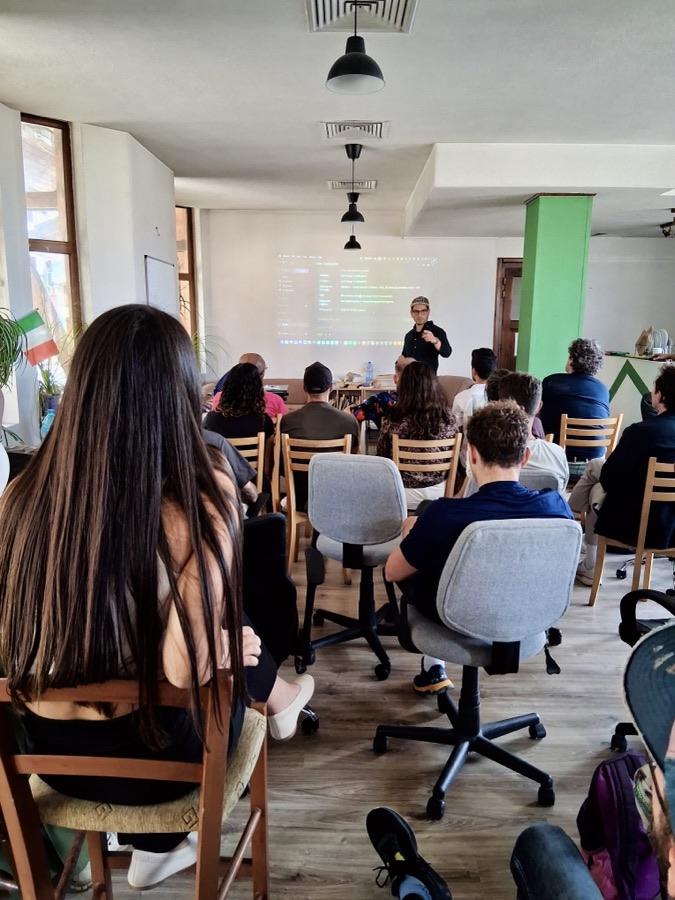
The best way to teach AI literacy is through examples. In
the workshops, I showcase my real company’s operations, sales and revenue
analytics to demonstrate what’s possible and what’s only hype. At the
same time I disclose what’s required by the EU AI Act, best practices, and
what’s required and forbidden by law.
2–4 hours·Max. 30 people live (no limit on remote)·Interactive, with Q&As·Real-world examples
Module 1
AI literacy
Seminar and live demo2 hours
30 min
Foundations
I explain Claude Code, MCP, skills, agents, routines and workflows in plain language, without any hype.
60 min
Examples & showcases
Live on a small team: offers, revenue roadmap, a weekly routine, outreach. Real data, real output, with Q&A running while it happens.
30 min
EU AI Act & guardrails
What applies to a team your size, in plain language: security, PII, approvals, and what not to automate. Q&A included.
30 min
Coffee break, or continue the next day
Module 2
Hands-on
Build your own brainOptional2 hours
If you decide to take it to the next level, I can guide your
team with building a working AI Brain, tailored to your organization’s
requirements and current pains.
30 min
Set up your tools
Everything running on your own machines, plus a map of what is realistically possible for your team.
60 min
First knowledge, first skills
Teach the model your company knowledge, then build the first skill and wire it into a workflow.
30 min
Q&A & refinements
Sharpen what each team built, fix what misbehaves, and agree what runs next week.
Included with every workshop this season
What your team takes home
AI literacy training as required under the EU AI Act, plus what is and isn’t allowed when using AI.
How to feed an LLM your company’s knowledge, keep contributing to it, and make it accessible to everyone.
How to build reusable, practical skills that become workflows your team and your agents can both use.
Rules for data protection, privacy and copyright, and when human oversight is required.
The hands-on module needs a Claude Code
subscription (or another LLM agent) in place before we start.
Workshops can also be tailored to a specific topic:
GDPR, PII, privacy, the EU AI Act, ethics, marketing, sales, safeguards,
automation or social media, focused on whichever pain points your team needs
most. Any of these can also run as a standalone 2-hour seminar or webinar.
Testimonials
What humans say
A few of them wrote it down afterwards.
…saved us more than 200+ hours of manual work
Worth every minute, and every cent. I participated in Toshi’s workshop a month ago. Since then, the AI brain for my company, built with Toshi’s help, has saved us more than 200+ hours of manual work from our employees and contractors. Our AI brain helped us optimised our interview scheduling, our marketing, our admin, and customer support for the most common topics and questions our clients usually have for us. It freed tons of time for our team to start working on the content and more creative side of our business. We will definitely work with you again.
One of our clients was building a real-estate platform with Claude hitting context limits and going into a loop of bug-fixing. Todor’s step-by-step approach in private sessions helped them streamline the development, create a feasible roadmap and launch the product, all within 4 weeks. The second brain now remains ingrained in the team culture just like Teams. Small changes that took a week are now replaced by quick prompts and a short review by a supervisor.
I already worked with agents before but seeing them live in action selling a physical product changed my whole perspective on how we should approach and use LLMs. Simple and complex examples explained for dummies.
I had the chance to participate in Todor’s workshop on setting up an AI Brain, and it gave me a much clearer perspective on how I can structure and organize my own AI repository to make my day-to-day workflow more efficient. What I especially appreciated was how practical and hands-on the workshop was — Todor shared examples from his own experience, showing how he uses the tools in his business and how they fit into real workflows, rather than just talking about AI in theory - that was very inspiring to see.
Stratégie et plan d’action ciblé pour projets engagés
Used with permission
Ways to work together
Start with two hours. Scale to a full brain.
Entry point
AI Literacy
In the AI seminar I explain the state of the art and demo what
can be done with AI, with live examples from my own company. I also take a deep
dive into ethics and law showcasing which rules apply and how to follow them.
Perfect for a training mandated by the EU AI Act.
After I teach your team what’s possible with AI through
examples, we go deeper and build a brain for your team, with its first skills
and workflows, ready to expand and improve on afterwards. We also start solving
your team’s operational pains with agentic examples and a roadmap.
I can also work closely with your CFO, Sales and Product
people, and bring in a team of data scientists, to build a full-fledged brain.
We focus on analysing and transforming operations for efficiency, and we
prioritise what wastes time and what brings revenue.
For programmesAre you an accelerator or incubator programme?
Explore the cohort partner options
The same workshop, sized for a whole cohort of 8–10 startups in
one room, followed by a private 30-minute session with each founding team,
tailored to their niche. Prices are flat per cohort, so the more teams you bring, the less it
costs per startup.
Workshop
€1,800
flat · the standard workshop price
4-hour interactive session
Live build on a real company
Quick-sheet & starter prompt pack
No 1 : 1 sessions
No brain repo setup or 30-day plan
For 10 startups: €180 each.
Recommended
Workshop + 1 : 1s
€2,800
flat · up to 10 startups
Everything in Workshop
10 × 30-min 1 : 1 sessions, one per startup
Tailored to each team’s niche
A prioritised 30-day plan per startup
Written follow-up notes after each session
For 10 startups: €280 each.
Cohort Partner
€4,200
flat · per cohort
Everything in Workshop + 1 : 1s
A brain repo set up per startup
Follow-up group session after 4 weeks
A second 1 : 1 round per startup
Brain repo review with written feedback
Async Q&A channel for 6 weeks
For 10 startups: €420 each.
Running a bigger programme, or spread across cities? There is
a remote webinar format too, at €1,800 for 2 hours live plus a 2-hour open
Q&A window afterwards, one price whatever the audience size, remote or on
premise.
Ask about it.
All prices net, excl. VAT. Remote delivery is
included; on-site anywhere in Europe adds travel & accommodation at cost. Beyond
10 startups it is €100 per additional 1 : 1, and let’s talk
about the room. Invoiced 50% on booking, 50% after the workshop. Every cohort also gets the
Ethical AI usage guidelines.
An AI brain acts on your live tools and your real data, so the
guardrails are part of the work, not a slide at the end. These five principles run
through every workshop and every engagement, and each team leaves with them written down,
alongside a plain-language read of what the EU AI Act
actually asks of a team your size.
FairnessRemove hidden bias from training data so the system treats all groups of people equally.
TransparencyKeep systems clear and explainable so people know how decisions are made.
PrivacyGDPRProtect user data and get proper permission before collecting personal information.
AccountabilityA human takes final responsibility for the actions and outputs of an AI tool.
SafetyDesign systems to do no harm, and to prevent malicious or dangerous uses.
The open challenges, named rather than glossed over
Algorithmic biasModels inherit the skew that is already in their training data.
Environmental impactTraining and running these models burns real energy and water.
Workforce disruptionRoles shift faster than teams can retrain for them.
Shared for education, not legal, security or compliance
advice. AI tools send data to third parties and can produce inaccurate output;
verify before acting, and keep personal data and secrets out unless you are cleared to
use them. Before deploying AI against real systems or customer data, get qualified legal
counsel on privacy and GDPR, and a security professional on your setup. You remain
responsible for what your AI agents do.
Regulation, in plain language
The EU AI Act, and what actually applies to you
The EU AI Act applies to any company or organization, no
matter how many employees you have or how much revenue you generate. Each
workshop focuses on concrete examples in a fun and engaging way so that you know
what applies to your field in action.
deepfakestransparencysocial scoringfinesAI literacyHRtalking to chatbotsemotions of staffpenaltiesThe EU AI ActAI watermarkingscreening CVshuman oversighttermination callshigh-riskbiometricsdisclosurebanssandboxesGPAI
The clock started here. Every deadline below is counted from this date.
Since Feb 2025
Banned practices
Harmful manipulation, exploiting people’s vulnerabilities, social scoring and biometric categorisation by sensitive traits are prohibited outright. Inferring the emotions of staff at work is on the list too.
Since Feb 2025
AI literacy duty
You have to take measures that build AI literacy for everyone operating AI on your behalf, employees, contractors and freelancers alike. I can brief your team and bring it up-to-date.
Since Aug 2025
Rules for model providers
Obligations landed on general-purpose AI model providers. Every member state also had to name its authority and put a penalty regime in place.
Since Aug 2026
Transparency duties
Say when someone is talking to an AI. Disclose deepfakes and AI-manipulated images, audio and video, and label AI-written text you publish on matters of public interest.
Since Aug 2026
Enforcement and fines
Penalties went live for the bans, the transparency duties, AI literacy and general-purpose models. For SMEs and startups the fine is capped at the lower of the fixed amount or the turnover percentage.
2Where are we now
By 2 Dec 2026
AI-generated content gets watermarked
Synthetic audio, images, video and text have to carry machine-readable marking. Systems that were already on the market in August 2026 have until this date to catch up.
2 Dec 2026
Two more bans arrive
Generating non-consensual intimate imagery and child sexual abuse material joins the prohibited list.
3What is still pending
2 Aug 2027
A sandbox in every country
Each member state has to run at least one AI regulatory sandbox, and SMEs and startups get priority access to it.
2 Dec 2027
High-risk, on its own
Screening CVs, ranking candidates and informing promotion or termination calls all land here, and so does credit scoring (Annex III). Deferred from August 2026, not cancelled.
2 Aug 2028
High-risk, inside a product
AI built into a regulated product as a safety component (Annex I).
And if you are a provider or training models, even more rules
apply.
If you’re a small teamWhat you need to know
Using AI to draft offers, run marketing, answer support or do
research is minimal-risk. There is no conformity assessment, no
CE marking and no audit waiting for you. Three duties still apply at any
size:
Don’t do the banned things. The realistic trap
isn’t science fiction. It is inferring emotions of
staff in the workplace, prohibited outright, and scoring people across
unrelated contexts.
Be transparent, live since August 2026. If a customer is
talking to a bot, say so. Disclose AI-generated or manipulated images, audio
and video, and AI-written text you publish on matters of public interest.
Support AI literacy in your team. Since the Omnibus this is
a duty to help people learn rather than to certify them, so a workshop and
written guidelines are a proportionate answer.
Know your role. You are almost certainly a
deployer of someone else’s model, not a provider, but
fine-tuning one or putting your own brand on it can make you a provider, with
far more attached.
Size cuts in your favour. For SMEs and startups fines are
capped at the lower of the fixed amount or the percentage of turnover
(Art. 99(6)), with priority access to regulatory sandboxes and a
simplified quality-management route for microenterprises.
The one that catches startups: using AI to screen CVs,
rank candidates or inform promotion and termination calls is
high-risk (Annex III), as is scoring
creditworthiness if you’re in fintech. Same category as critical
infrastructure; it just moved to December 2027.
If you’re a large companyWhere to put resources
The cost isn’t the paperwork on any one system.
It’s knowing what you have. Budget for the programme, not the
checklist:
An AI inventory and a classification process. Every system
in the organisation sorted into banned / high-risk / transparency-only /
minimal, and kept current as teams ship. This is the long pole.
A high-risk programme if you touch HR, credit, insurance,
education, biometrics or critical infrastructure: risk management, data
governance, technical documentation, logging, human oversight, accuracy and
cybersecurity, a quality management system, conformity assessment, EU database
registration, post-market monitoring and incident reporting.
Deployer duties, separately. Most enterprises deploy
someone else’s high-risk system and still owe: use per instructions,
competent human oversight, log retention, informing workers and their
representatives before a high-risk system goes live at work, and
telling affected people. Credit and insurance deployers also owe a fundamental
rights impact assessment.
Registration still applies to systems you self-assess as
not high-risk. The proposed exemption was rejected; only the
administrative footprint got lighter.
Fines the normal way round. Up to €35M or 7% of global
turnover, whichever is higher, for prohibited practices.
Use the deferral to build, not to wait. December 2027
sounds far away; harmonised standards, supplier contracts and evidence
pipelines don’t build themselves in a quarter.
Orientation, not legal advice. A
plain-language summary of a long regulation, current as of September 2026 and
simplified on purpose; what you owe depends on your specific systems, sector and
role. For anything you intend to rely on, get qualified legal counsel. The
workshop points you at the right questions, it doesn’t answer them for your
business.
Who's behind it
Todor Lazov
Fractional CTO · Product Lead & CTO at goodbag
Serial tech founder, nerd by heart, and a bridge between
business and technology. I don't advise from the sidelines; everything in
the workshop runs my own company every day.
The things teams and leaders ask most before we start, all
about the AI brain, the fractional CTO service, and the hands-on workshop.
What is an "AI brain" for a team?
A new way of working with LLMs like Claude and ChatGPT. Out of the box,
those models know very little about your company, your team or your clients, so
so they assume, and most of the time they assume wrong.
An AI brain is built on three things:
Your company background: what you do, who you sell
to, who your clients are, how you price and how you sound.
A connection to the tools your team already uses:
Slack, Teams, Gmail, Calendar, Drive, your CRM, so it can pull the
relevant files and data and actually work with them.
Skills: the tasks your company performs, written down
once: generating and sending offers, analysing revenue, automating
marketing.
Those three parts, the background knowledge, the tool connections and the
skills, are what make an AI brain, and they come together through workflows
and agentic workflows. Once your knowledge is structured and shared,
everybody can use AI the right way instead of poking at a chatbot
with shallow prompts.
Will an AI brain magically solve my company’s problems?
No, and be sceptical of anyone who says otherwise. The hype has done
real damage here: LLMs and agents get sold as the answer to every problem,
which sets teams up to be let down by tools that are genuinely remarkable.
What they actually are is very powerful instruments. Used
well, they take the mundane work off your team, produce real assets, and can
move revenue. But power is not judgement. They need precise, responsible
guidance: the inputs, the rules and the priorities that come out of your
vision, mission and values.
An AI brain will not fix poor leadership. It scales the
direction you give it, faithfully, including a bad one.
Which is exactly why it is worth building properly. When the repetitive work
stops eating the week, people stop spending Tuesday copy-pasting between tabs
and start making things that did not exist before. Nobody is bored, the
interesting problems finally get attention, and you get
breathing room for innovation instead of a backlog of
admin.
So set the expectation honestly: this is a daily tool, not a miracle. A
super-powered calculator; an intelligent spreadsheet that can act on what it
finds. Nobody ever expected the spreadsheet to run the company, but it
completely changed what a small team could get through in a week. An AI brain
is that shape of change, for everyone.
What does a fractional AI CTO actually do?
In the Fractional AI CTO Service, Todor works alongside your
CFO, Sales and Product people to capture and structure the organization's
scattered knowledge, covering processes, pricing, sales motions and product know-how,
and turn it into a company brain the whole team can use. It's delivered with
an extended team including data scientists, and the focus is always on
efficiency, process optimization and the segments that actually increase
revenue, not technology for its own sake.
How much does the AI workshop cost?
The AI Literacy seminar is €1,800 flat for 2 hours,
half-day session for teams of up to 10 people or a leadership circle. One
price whether it runs remotely or on-site; travel and accommodation are added
at cost for on-site delivery. All prices are net, excluding VAT.
Every workshop this season also includes an AI hacking quick-sheet, a
starter prompt with guidelines for your AI Brain, the
Ethical AI usage guidelines, yours to keep and reuse
after the session, plus a bonus 30-minute 1 : 1 session two weeks
afterwards.
Running a whole cohort rather than one team? The same workshop is priced
per cohort, from €1,800 for the session up to €4,200 as Cohort Partner. See
the cohort partner options.
What happens in the workshop?
It's not a lecture. It's a live, example-driven demonstration run on a
real company, with laptops open rather than slides playing. Using LLMs like
Claude Code, we show skills being built, quotes automated, the brain
repository connected to real tools, designs generated, deals closed through
outreach sequences, and revenue analyzed. Real data, real output, including
the parts that need a second attempt.
It runs in two modules of two hours. Module 1,
AI literacy, is the seminar and live demo: 30 minutes of foundations
(agents, connected tools, skills and workflows in plain language), 60 minutes
of examples and showcases, and 30 minutes on the EU AI Act and
guardrails: security, customer data and GDPR, approval
gates, and what not to automate. That module can also be booked on its own as
a 2-hour seminar or webinar.
Module 2, hands-on, is optional and can run the same day
or a separate one: 30 minutes setting up your tools and mapping what is
realistically possible, 60 minutes teaching the model your company knowledge
and building the first skill and workflow, then 30 minutes of Q&A and
refinements. It needs a Claude Code subscription (or another
LLM agent) in place before we start.
Throughout, we discuss how each example maps to your business, and Q&A runs
across the session rather than being saved for the end.
Do you deliver remotely or on-site?
Both. Workshops and engagements run remotely, or on-site anywhere in
Europe, at the same price. For on-site sessions, travel and accommodation are
added at cost on top of the quote. The default working language is English.
Remote works better than most people expect, because the session is
screen-driven either way: you are watching a real company's tools being
operated, and your team builds on their own machines. On-site tends to win
when the point is getting everyone in one room with nothing else in the
calendar, which is usually why programmes and leadership circles choose it.
For larger audiences there is also a fully remote webinar format: two
hours live plus a two-hour open Q&A window afterwards, at one flat price
whatever the headcount. Details here.
Who is this for?
Small teams and startups that want to run like a much bigger company;
leadership circles under pressure to "do something with AI" but wary of
hype-driven investments; and mid-sized companies with real process and data
landscapes ready to build their own AI brain, plus
accelerator and incubator programmes running a whole
cohort at once.
It does not depend on having engineers. The people who get the most out of
it are usually the ones drowning in repetitive work in sales, support,
marketing and operations, because the whole point of a shared brain is that
everybody can use it, not just the technical half of the team.
If AI feels like it's overpromising and underdelivering for your team, this
is for you.
Is this suitable for accelerator programmes?
Absolutely, yes. Todor has been through several
accelerator programmes as a founder, including IKEA Bootcamp, Maze-X and the
BMW Foundation Respond accelerator, so this is built from the inside of a
programme, not guessed at from outside. That experience decides the format:
what actually moves a cohort forward in one session, and what is theatre.
A founder’s time is the scarcest thing in the building, and the
hardest part of the job is changing hats: fundraising in the morning,
support tickets at lunch, product by evening. The AI brain is what takes the
trivial operations off that list. Every startup gets a private session,
a timeline built for its own niche, and mentoring across several touchpoints,
so that by demo day the teams are spending their hours on mission, vision and
traction while the repetitive work runs itself.
Cohort pricing starts at €1,800 flat for the workshop, with a 30-minute
1 : 1 per startup from €2,800. See the
cohort partner options. For larger programmes there is
a remote webinar format at one flat price, whatever the audience size.
How much does the Fractional AI CTO Service cost?
The Fractional AI CTO Service is priced custom per engagement, because scope
depends on the size of your organization, the state of your knowledge and
the outcomes you're after. Many clients start with the €1,800 AI Literacy
seminar to prove the value in two hours, then move into the full service. Get
in touch and we'll figure out the right starting point together.
What about AI and ethical usage?
It is part of the work, not a disclaimer at the end. Five principles run
through every workshop and engagement: fairness (removing
hidden bias from training data so the system treats all groups of people
equally), transparency (systems that stay explainable, so
people know how a decision was made), privacy (protecting
user data and getting proper permission before collecting personal
information, GDPR included), accountability (a human takes
final responsibility for what the tool does), and safety
(designing to do no harm and to prevent malicious or dangerous uses).
The open challenges get named rather than glossed over: algorithmic bias,
the environmental cost of training and running these models, and workforce
disruption. Every team leaves with the
Ethical AI usage guidelines written down, including
what to refuse to automate. This is shared for education, not as legal,
security or compliance advice; for anything touching customer data or
production, bring in qualified legal counsel and a security professional.
What do I need to do about the EU AI Act?
Less than you fear if you are small, and more than a checklist if you are
large, because what you owe depends on what you use AI for,
not how much of it you use.
A small team using AI for offers, marketing, support or
research sits in the minimal-risk tier: no conformity assessment, no CE
marking. Three duties still bind you at any size: don’t do the
banned things (inferring staff emotions in the workplace is the realistic
trap), be transparent when someone is dealing with AI or with synthetic
content, and support AI literacy in your team. Fines for SMEs are capped at
the lower of the fixed amount or the turnover percentage. The one
that catches startups: putting AI into CV screening or hiring decisions is
high-risk, and so is credit scoring in fintech.
A large company should budget for the programme rather
than the paperwork: an inventory of every AI system and a way to classify
them, a high-risk compliance programme where it applies, and the deployer
duties that come even when the system is someone else’s,
including informing workers and their representatives before a high-risk
system goes live at work.
Timing as of today: the banned practices and the AI-literacy duty have
applied since February 2025, and the transparency duties since 2 August 2026.
The high-risk obligations were pushed to December 2027 and August 2028 by the
Digital Omnibus, deferred rather than cancelled. Full breakdown in
the EU AI Act section. Orientation only, not legal
advice.
How is this different from generic AI consulting?
Everything is proven on a real company first, and shown live. Todor is
Product Lead and CTO at goodbag, a small impact startup that uses its AI brain
as a daily driver to overperform with minimal operations, so every example is
one that already survived contact with real customers, real pricing and real
deadlines, not a sandbox demo.
That also means facing the same constraints you do: a tiny team, no budget
for headcount, regulated and sustainability-adjacent data, and customers who
notice immediately when something reads as machine-made. The workshop covers
what that takes in practice, including a fixed brand identity and a designer’s
template so output never looks AI-generated, and the
ethical guardrails that keep it defensible: fairness,
transparency, privacy and GDPR, accountability and safety, plus the open
challenges nobody has solved yet.
The guiding principle is simple: a fool with a tool is still a fool.
The tool isn't the transformation; the shared brain, the skills and the
structure are.
Did you use an AI brain to build this?
Yes, and be wary of anyone in this field who claims they didn’t.
This site, its copy and a good deal of the tooling behind it were built with AI
assistance, using the same brain-and-skills approach I would set up for you.
Selling a way of working I don’t use myself would be a poor advertisement
for it.
Everything here is human-led. AI assisted; it did not
decide.
The workshops are led by a person, start to finish. Every example in them is
a real problem a founding team actually hit and solved, including the
awkward ones: where automation stopped being worth the trouble, where the
ethics got uncomfortable, where legal compliance changed the design. No model
produced that experience. It came from doing the work and getting some of it
wrong first.
And when you get in touch, you reach me. There is no chatbot on this site,
no agent triaging your message and no automated qualification step. Your
message lands in an inbox and I answer it myself.
Transparency is one of the five principles in
every workshop, and the
EU AI Act’s transparency duties are part of the
guardrails block. It would be hard to teach that with a straight face and then
be vague about my own site.
Do you also help with sustainability?
Yes. Alongside the AI work, Todor offers sustainability-first
consulting: mapping direct and indirect impact
with real data, building a Theory of Change to measure and scale impact,
AI strategy and adoption, and shaping customer experience for 5-star
products, grounded in impact ventures like goodbag and collaborations with
IKEA, Denner, Nestlé and Recup.
Still have a question? Ask directly.
tell me about your team and what's eating your time.
Contact
Ready to give your team a brain?
Tell me about your team and what's eating your time.
We'll figure out whether a workshop or the full Fractional AI CTO Service is the
right starting point.